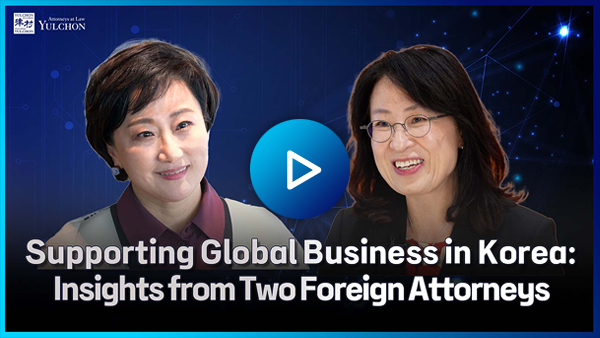
Supporting Global Business in Korea: Insights from Two Foreign Attorneys
In 2024, Yulchon has continued to strengthen its presence in South Korea by actively engaging with the international community, particularly through its collaboration with foreign chambers of commerce. By supporting foreign companies operating in Korea, our attorneys are at the forefront of fostering international business relations and delivering tailored legal solutions.
In this interview, we are joined by two distinguished foreign attorneys, Ms. Jay-Son YANG (JSY) and Ms. Nina H. KIM (NHK), who have played key roles in these efforts. With their diverse professional backgrounds and extensive experience in cross-border legal matters, they share their personal stories and invaluable insights into the legal landscape for foreign companies in Korea. In this conversion, they discuss the benefits of their initiatives, the challenges they have encountered, and their advice for aspiring attorneys seeking to navigate the complexities of international legal practice.
Hello, before we dive into the interview, could you please introduce yourselves?
-
JSY
Hello, my name is Jay-Son Yang. I joined Yulchon's Corporate & Finance Group in 2021.
As a foreign attorney, I have had the privilege of working with a diverse range of corporate clients across various industries, which has been truly an exciting and inspiring experience.
Before joining Yulchon, I served as in-house counsel at Citibank Korea Inc. for over 16 years, specializing in corporate governance and financial regulatory matters. During my tenure, I played a pivotal role in Citi Korea's transition in 2004 from a U.S. bank branch to a locally incorporated entity following its acquisition of a local bank. This included facilitating post-transitional integration, and ensuring effective communication between Citi's headquarter and Korean regulatory authorities. In addition, I assumed a dual-hat role within Citi Korea, representing the bank's government affairs team. In this capacity, I engaged in legal advocacy and collaborated with organizations such as AMCHAM Korea. This experience, gained in a highly regulated industry that demands both deep local knowledge and global communication skills, now informs my work at Yulchon, where I support global companies navigating similar challenges. -
NHK
Hello, my name is Nina Kim, and I am a senior foreign counsel and partner in the Corporate & Finance Group at Yulchon.
I have worked for almost 30 years advising on a wide range of cross-border mergers and acquisitions transactions.
Throughout my career, I have counseled clients on numerous high-profile transactions, including joint ventures, acquisitions and strategic alliances made by multi-national companies in Korea across various industries, including chemicals, pharmaceuticals, food and technology. In addition, I routinely assist foreign companies, whom I have advised from the start of their Korean operations, with on-going operational issues, including compliance, regulatory and commercial matters.
Prior to joining Yulchon in 2017, I was a member of Kim & Chang, another prominent Korean law firm in Seoul, for 12 years and, before working in Seoul, I worked at law firms in New York, including Paul Hastings, a leading international law firm.
Having both earned your U.S. bar qualifications, you have impressive careers, yet your professional journeys are remarkably different.
Ms. Kim, you built your career in New York, gaining experience at several global law firms before returning to Korea and joining Yulchon.
Ms. Yang, on the other hand, spent your early career in Korea, took time off before pursuing law school in the U.S.,
and later worked as in-house counsel at a foreign bank in Korea for nearly 20 years.
Given your diverse paths, how have these experiences influenced your approach to working with foreign clients, and how do they shape your current role at Yulchon?
-
NHK
Having grown up in the United States and spent a decade working at leading global law firms in New York, I bring a unique cultural connection and understanding to my work with foreign clients.
This background allows me to not only meet the high legal standards expected by global clients but also anticipate their needs and communicate in a way that resonates with their perspective.
A client once shared with me, "We enjoy working with you because you understand what we need to know. We have worked with lawyers in other countries, like Japan, who speak and write flawless English, but the work product often reveals a cultural disconnect. With you, it's different—you truly understand our expectations because you are American."
This feedback reflects the core of my approach: combining the professionalism and insights shaped by my U.S. background, including legal training, with a practical understanding of Korea's legal landscape. It is this ability to connect on both a professional and cultural level that I believe sets me apart in helping foreign clients navigate legal issues in Korea. - JSY I was born and raised in Korea, where I completed all my education and built the early part of my career, except for my law studies and a brief work experience in the U.S. My predominantly local background has been instrumental in helping foreign companies adapt to the Korean market as I provide insights into regulatory trends, legislative changes, and corporate culture dynamics. Additionally, my experience as in-house counsel provided me with a deep understanding of the client's perspective, particularly in managing legal and reputational risks. This perspective continues to inform my practice at Yulchon, where I work with clients across industries such as manufacturing, energy, and general corporate sectors. Most of these clients are foreign companies, and I focus on bridging the gap between their expectations and the complexities of the Korean legal landscape by offering clear, concise and practical solutions. Clients have often appreciated my ability to deliver tailored advice that effectively addresses their needs, enabling them to navigate Korea's challenging regulatory environment with confidence.
In your work with the foreign chambers of commerce in Korea, what are some of the key benefits for foreign companies operating in Korea? How do these activities help foster international business relations to both businesses and law firms?
-
JSY
I would like to give you two examples from my experiences: one as a client, and the other as a law firm partner.
In or around 2012, foreign financial companies in Korea faced a significant legal challenge related to cross-border data transfers. With the increasing adoption of cloud-based services, and global IT systems where client data is centrally managed to provide efficient services to corporate clients, these global systems risked violating local data privacy laws. In response to industry concerns, the foreign chambers of commerce in Korea formed a task force to research international practices, deliver policy recommendations, and propose legislative measures to policymakers and regulators in collaboration with various financial companies. This collective effort successfully culminated in the creation of Korean outsourcing regulations for financial companies, which provided much-needed clarity and compliance guidelines.
Another example involves a foreign corporate client I closely worked with throughout the year. The client, involved in Korea's hotels and tourism sector, first reached out to me after we exchanged business cards at a chambers event. Months later, I received an urgent call from the client's Manila headquarters regarding a decade-old transaction with a Korean conglomerate. Within 24 hours, I coordinated a call, identified the necessary experts at Yulchon, and delivered an initial analysis that addressed the client's concerns. This timely response helped build trust, and the client has since engaged Yulchon as its ongoing legal counsel for its Korean investment projects. -
NHK
Korea offers an exceptional environment for foreign companies, thanks to its highly educated talent pool and leadership in key industries such as technology, particularly the semiconductor industry.
Additionally, Korea's global influence in entertainment, beauty, and culture—through K-Pop, K-Beauty, and K-Drama—creates exciting opportunities for foreign investment.
Companies like Netflix, for example, have recognized the potential and made significant investments.
Foreign chambers of commerce in Korea play a vital role in this ecosystem by creating platforms where foreign businesses and law firms can connect, exchange know-how, and share best practices for operating in Korea's unique market. These chambers also provide opportunities to engage with Korean regulators, fostering dialogue and offering insights that benefit all parties involved.
This interest from foreign companies underscores the need for law firms in Korea with established expertise in navigating Korea's legal and regulatory landscape while also understanding the unique needs of international clients. By working closely with foreign chambers of commerce, law firms like ours help facilitate these connections and collaborations, strengthening international business relations and enabling companies to capitalize on Korea's dynamic opportunities.
Can you share a specific occasion or initiative from this year where you helped organize or attended an event involving foreign companies? What made that experience particularly memorable or impactful?
-
NHK
One of the most memorable events I attended this year was the AmCham Ball, held in June.
The event was particularly special due to the strong representation from key figures in the business and diplomatic communities,
including CEOs and executives from major U.S. companies, law firms collaborating with these companies, and members of the U.S. Embassy.
What made this experience so impactful was witnessing firsthand the deep and enduring relationship between Korea and the U.S. It was heartwarming to reconnect with so many individuals who share a commitment to fostering international collaboration and strengthening business ties. The event provided a unique opportunity to not only celebrate this longstanding partnership but also to engage with influential leaders and exchange insights that will continue to shape business relations between the two nations. -
JSY
To introduce a couple of recent memorable events I attended: The first was AMCHAM's Women's Committee event where I participated as one of three panelists.
I shared my experiences and perspectives on communicating with clients from a business standpoint.
Although I was the sole law firm representative, the discussion confirmed that trust is a universal value across industries.
The second event that I found particularly enriching was a Korea-German Windfarm Business Forum, hosted by the Korea-German Chamber of Commerce in October last year. With Germany's leadership in renewable energy, the seminar brought together local developers, suppliers, research institutes and advisory groups like us. Participants benefited greatly from the forum, gaining valuable insights and networking opportunities through the distinguished speakers and panels from relevant fields abroad.
I believe these two events perfectly illustrate how chambers of commerce in Korea facilitate the sharing of information, foster collaboration, and support the growth of their member companies.
What are some of the key legal challenges you have encountered while supporting foreign clients here in Korea, and how have these challenges shaped your approach to providing legal advice?
-
NHK
One key challenge I encountered early in my career here in Korea occurred when a client, with whom I had a shared history at Paul Hastings, reached out for advice on a cross-border M&A transaction.
He asked, “Nina, I know you worked at Paul Hastings in New York, and I know you understand M&A.
I know M&A and do not need a 'M&A 101.' Tell me what do I need to know about the differences between an M&A in Korea and one in the U.S.?”
This was not an easy question to answer on the spot, especially in "real time," but I was able to provide clear guidance. Fifteen years later, I continue to work with this client, which underscores the lasting value of providing concise and actionable advice.
Through experiences like this, I have learned that foreign clients often seek legal advice that is not only thorough but also easy to understand and directly applicable to their specific needs. To ensure clarity, I have found that providing real-world examples can be particularly helpful, as they bridge the gap between complex legal concepts and practical solutions. This approach has shaped my strategy for offering advice that is both succinct and useful, addressing clients' legal concerns while respecting their time and business objectives. -
JSY
There is a survey conducted among CEOs of foreign companies in Korea, which aims to understand how foreign investors assess
the business environment in Korea and identify what they perceive as the biggest challenges in doing business here.
Every year, without exception, the top management of foreign companies in Korea highlights two primary issues: uncertainty and inconsistency in regulatory guidance, and rigidity in the labor market. If I am not mistaken, many foreign companies spend significant time and resources repeatedly seeking interpretations of laws from regulatory authorities overseeing their businesses. Drawing on my experience as in-house counsel for a foreign company, I have experienced the same frustrations on numerous occasions. Understanding the types of questions clients are likely to ask, I anticipate client concerns by preparing foundational explanatory materials on key topics, such as financial regulatory trends and legislative developments relevant to the client's interests. I also ensure these materials are regularly updated and shared promptly with clients.
How do you see your role evolving in the future as the relationship between foreign companies and local legal services continues to grow?
-
JSY
It is fascinating to observe how foreign companies in Korea have evolved over time, particularly in terms of the types of businesses entering the Korean market,
such as manufacturing, IT and fintech, as well as changes in investment structures and local governance models.
For example, unlike early generations of foreign investors, many CEOs of local entities of global companies are now Korean nationals who have spent their entire careers within these organizations.
For such local management, who possesses extensive experience and understanding of the Korean business environment,
there is less need to explain the dynamics and cultural sensitivities of Korean corporations—something that foreign CEOs typically require more time to grasp.
In emerging industries with high growth potential in Korea, such as renewable energy, foreign companies are increasingly forming collaborations with the local businesses or government-owned corporations. This is a relatively recent trend compared to the past. It implies that our role as legal counsel has evolved beyond advising solely foreign companies, now encompassing support for domestic corporations that are partnering with foreign companies. This expanding scope reflects the growing interconnectivity between foreign and local businesses in Korea's dynamic market. -
NHK
As artificial intelligence (AI) continues to evolve, becoming both more accessible and reliable, I anticipate that clients will increasingly question the need for high-cost legal services.
With AI capable of handling certain tasks, law firms will need to work harder than ever to demonstrate their "added value" beyond what technology can provide.
In the future, I see my role evolving to focus on offering strategic insights and tailored legal advice that go beyond the transactional or routine tasks that can be automated. The human element—deep understanding of the client's business, cultural nuances, and the ability to navigate complex legal landscapes—will remain irreplaceable. Law firms will need to leverage technology, not only to enhance efficiency but also to provide smarter, more targeted solutions.
My goal will be to continue offering exceptional service that combines legal expertise with practical, business-focused advice, ensuring that clients feel the value of our work in every interaction. This approach will help me remain a trusted advisor as the legal industry adapts to an increasingly technology-driven future.
What advice would you offer to foreign companies looking to expand or invest in Korea from a legal perspective?
-
NHK
For foreign companies looking to expand or invest in Korea, it is critical to understand that Korea has its own unique set of laws, regulations, and regulatory positions.
While it may be helpful to draw parallels with how similar issues have been addressed in other jurisdictions, such as Japan, an approach that works elsewhere may not always be applicable in Korea.
To navigate the complexities of the Korean legal landscape, it is essential to work closely with local legal advisers who have the expertise and experience to provide tailored guidance. Their deep understanding of both the legal environment and the regulatory nuances will help ensure that your approach is both effective and compliant with Korean law. - JSY While there is always room for improvement, I firmly believe that Korea is among the most advanced nations where contracts are respected and upheld, with a judicial system that is both transparent and reliable in enforcing them impartially. The country takes pride in its highly skilled human resources across all sectors, including legal and administrative support, consistently meeting global standards of excellence. Moreover, Korea's growing cultural influence, fueled by its IT competitiveness, serves as an catalyst, positioning the country as an increasingly attractive destination for the next wave of foreign investment.
As we conclude today's interview, what advice would you give to aspiring attorneys seeking to thrive in this area of work, especially in navigating cross-border legal issues and building meaningful relationships with international clients?
-
NHK
To thrive in this area of work, especially when navigating cross-border legal issues and building meaningful relationships with international clients, it is essential to truly listen to the client.
Take the time to understand not just their immediate legal needs, but also their broader business objectives and expectations.
Being proactive is key—anticipate issues before they arise and think creatively to find solutions that meet the client's needs. Always strive to "think outside the box" and offer innovative approaches.
Ultimately, it is a privilege to be entrusted with a client's legal matters. We must repay that trust by dedicating ourselves to delivering the highest quality work, providing thoughtful and effective guidance, and fostering long-term, mutually beneficial relationships. -
JSY
First and foremost, where you obtained your law degree may not be as important as you might think.
This is especially true when advising clients in cross-border business matters or striving to become a competent and strategic advisor in your client's decision-making process.
What often matters more is how well you understand the industry you are involved in—the emerging trends, prospects, challenges, and dynamics that your client seeks to navigate and prioritize.
Foreign investment by global companies is not an isolated activity but a highly complex economic endeavor influenced by the political, economic, and regulatory environments of the countries involved. Whether you are working as an in-house counsel or at a law firm, I would emphasize the importance of understanding the diverse perspectives of various stakeholders involved in any given issue. This mindset not only deepens your knowledge and experience but also broadens your perspective. In turn, this enriched understanding builds trust with your clients and encourages them to continue relying on your advice. As a final piece of advice, I recommend connecting with people from fields outside your own more often. Expanding your network in this way can help you discover new interests and unlock greater potential for both personal and professional growth.